
Modernised stack creates 76% reduction in Operating Costs
Maven Technologies executed a massive architectural overhaul for a venture capital firm and its portfolio startup, transforming a legacy platform into a modern serverless system at a fraction of traditional operational costs.
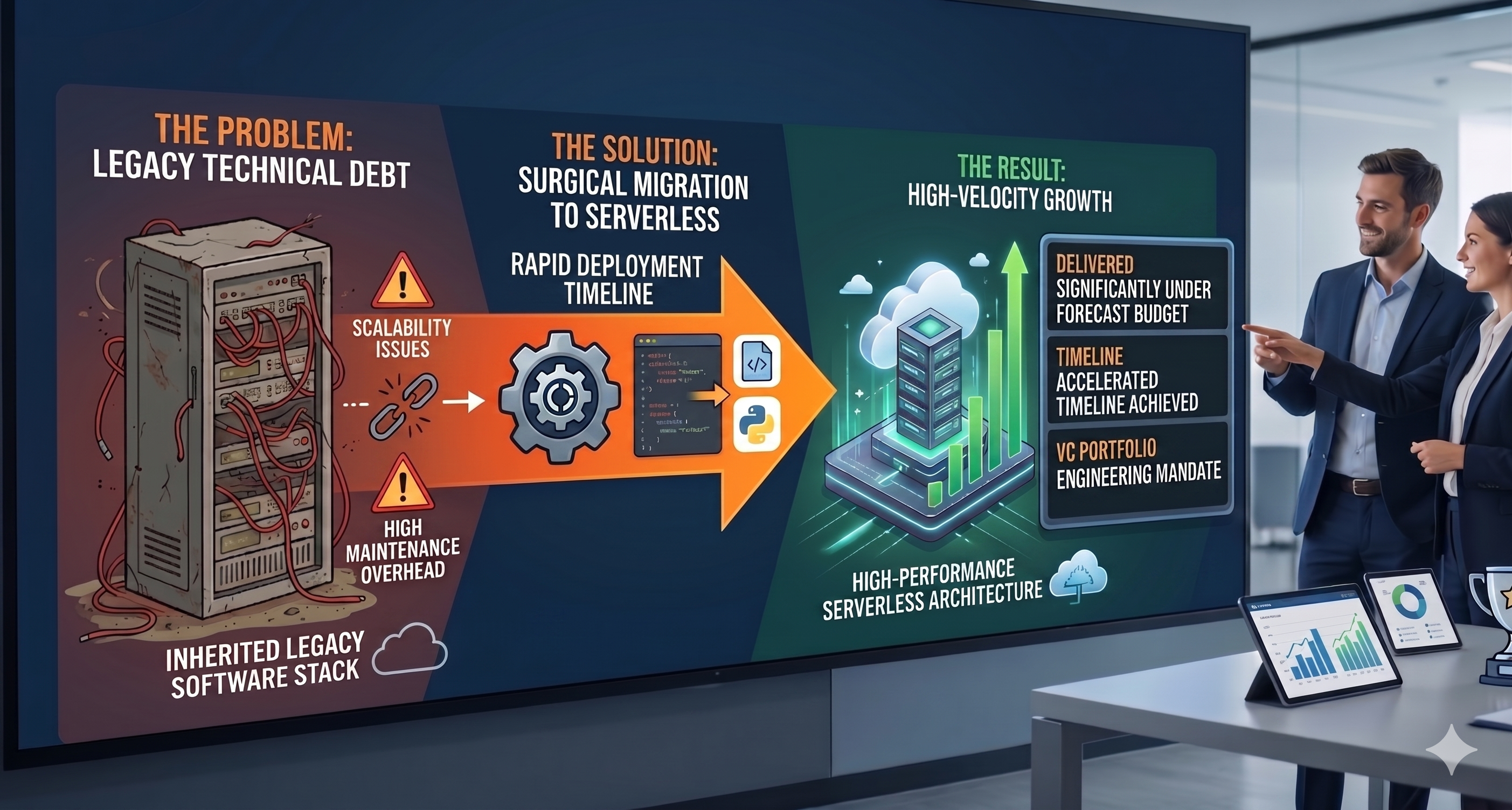 In the high-stakes world of venture capital, technical debt can be the silent killer of promising startups. When early, “scrappy” builds hit a scalability wall, founders often find themselves burning through excessive runway just to keep their platforms afloat. Maven Technologies recently collaborated with a New Zealand-based venture capital firm and its portfolio startup to address these exact hurdles through a rapid technical intervention.
The Problem: Technical Debt and Scalability Walls
The venture capital firm was facing a recurring industry challenge: their portfolio companies were struggling to manage legacy systems that inhibited growth. The Wellington-based startup had reached a critical point where its existing platform was bogged down by technical debt.
The reliance on founder-led, often unproven technical teams led to disparate architectures that required high maintenance overhead and were difficult to scale. To protect their investment and ensure platform performance, the VC firm required a solution that could bypass the traditional, bloated enterprise rebuild process.
The Approach: Surgical Recovery and Modernisation
Maven Technologies executed a precisely scoped technical recovery designed to modernise the infrastructure without the typical months-long turnaround.
Triage and Stabilisation
The first step involved immediate action to stabilise the startup’s existing legacy stack. By addressing immediate performance issues first, Maven ensured the platform remained functional while the larger migration was planned.
Modern Architecture Migration
Following the stabilisation, Maven entirely migrated the platform to a modern, serverless architecture using a high-performance backend framework. This transition moved the client away from legacy constraints and into a high-velocity environment designed for optimal resource utilisation and performance.
Aggressive Milestone-Based Delivery
The project was executed with a strict timeline divided into three core phases:
- Plan & Onboard: 1–2 weeks
- Delivery: 1–3 weeks
- Test & Launch: 1–2 weeks
The Results: A New Paradigm for VC Engineering
The engagement resulted in a fundamental shift in how the VC firm views technical risk and portfolio management.
Extreme Budgetary Outcomes
While standard internal rebuilds typically result in massive capital expenditure, Maven delivered the entire project significantly under the forecasted budget, yielding a highly favorable ROI metric. This demonstrated that architectural modernisation could be achieved well within strict financial constraints.
Standardised Investment Model
The success of the project was so significant that the VC firm altered its primary investment strategy. Instead of providing unallocated funds for founders to hire their own tech teams, the firm now mandates Maven Technologies as the central engineering force in their investment term sheets. This guarantees a unified architecture and strict financial adherence across their entire portfolio.
Conclusion
By partnering with Maven Technologies, the VC firm successfully de-risked its investment and established a new standard for startup engineering. The project proved that moving from legacy stacks to modern, serverless environments can be done rapidly and within highly favorable financial metrics, providing a clear roadmap for other firms looking to drive internal innovation without the burden of technical debt.
Frequently Asked Questions
For the nzvc engagement, the entire process—from planning to launch—was completed within a strict 7-week window. This included a 1-2 week onboarding phase, 1-3 weeks for delivery, and a final 1-2 week testing and launch period.
Maven transitioned the platform from an existing, bogged-down Ruby stack to a modern, high-velocity, serverless Python FastAPI architecture. This shift ensures long-term scalability and performance.
Maven uses a strictly milestone-based engagement model. This ensures that the client only pays for completed phases, which drastically reduces financial risk. For the startup, the entire architectural recovery was delivered for a minimal total cost.
Upon final settlement and project completion, all intellectual property, code repositories, and cloud infrastructure are seamlessly handed back over to the client.